Monday, March 16, 2015

My lines of code are my CHILDREN! - Interaction with development

In a word, empathy. 

As obnoxious as that bug is,
how obvious it is to you that it is a problem,
how silly you think it was that it was missed...

Image courtesy of liveactionnews.org
...this code has a parent. And every parent thinks their child is beautiful. Put yourself into their shoes. What if you had your test suites audited by the developers for spelling errors, or general clarity? Your mood would probably change very quickly to a defensive posture. 

It takes a lot to create code. You may not understand this as a new tester, but it is exhausting to create something that works, even if it just works enough to pass initial inspection. These guys (and gals!) may have spent the better part of their waking hours in the last few days (or weeks) going over their logic and syntax. 

In a word, most code, however functioning, is a labor of love. 

Don’t disparage it. :) Help the developer nurture it by showing a reason why a customer may not like it.

Report it, and follow up.

Also, let your developer know how much you appreciate their work. That will go quite far!

Good Bug Hunting!

PS: If you are having trouble feeling empathy for your developer, go write some code that does more than a "Hello World" block. That has a way of helping one feel some humility. :)

Sunday, September 15, 2013

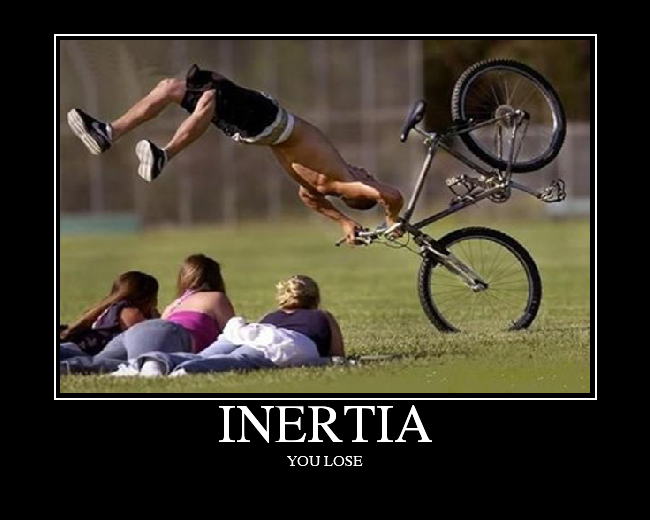
Policy By Interia


A malady suffered by nearly every person on this planet, individually or collectively. Google defines Inertia as "a tendency to do nothing or to remain unchanged." Also, "a property of matter by which it continues in its existing state of rest or uniform motion in a straight line, unless that state is changed by an external force." Another: "resistance to change in some other physical property."Physics The tendency of a body to resist acceleration; the tendency of a body at rest to remain at rest or of a body in straight line motion to stay in motion in a straight line unless acted on by an outside force." Finally: "Resistance or disinclination to motion, action, or change."

The lesson here is clear: many of us, either by necessity or by lack of motivation, find ourselves making our own habits into a hard and imperceptible policy of behavior. We don't change because "this is what [we] do". We've always done it this way. And we will always do it this way.

For me, if I think about it, this stings a bit. In how many ways am I "comfortable" with the status quo - even if it is an inferior way of doing something? Am I creating my test plans from a template? Am I following my test scripts verbatim? Am I doing ad hoc testing because the inertia-based policy has been to not create a test plan?

I urge all of us to question the policies in our lives. If they have been made with foresight, they will stand the test of time and of testers' questions, being validated and confirmed by those questioning it. If the policies in our lives have been made by inertia, they will crumble with the least bit of scrutiny.

This questioning is what separates the professional tester from the amateurs. This is what makes makes the systems-under-test more robust. And although we cannot change most of these policies overnight., our questioning and positing of a better way, can indeed make even the most entrenched policies change their direction.
Our constant small suggestions for improvement can change the outcome of the game

By the way, companies pay big bucks to have this sort of individual on their team. Just as long as the questioning is done in the right way. More on that to follow. :)

Sunday, May 15, 2011

The Tonka Theory

Dear Tonka - you sure know how boys think
(Image courtesy of luv2bid.com)

As a kid, I loved Tonka trucks. I loved the idea of the power of the life-sized trucks they represented, and the holes those machines could dig and the dirt they could move.

After first getting these toys as gifts, I would purposefully seek out any construction going on locally in order to watch those machines work. I'd watch, agape, as a backhoe would dip its shovel into solid ground like it was liquid and pull out a massive chunk of earth. I'd run back to my backyard, inspired, grab a shovel to start digging a hole. Only, the ground was really, really hard. And my small little frame did not have the leverage to pull a shovelful of dirt out of the ground. I'd give up, eventually, only to start this whole process again when I saw another truck.

(Image courtesy of
babywit.com)
Lately, I've been attempting to hold weekly QA learning sessions at my work during the lunch hour once a week. These meeting were originally created in order to help each of us share our domain experience as well as any "relevant" methods or practices.

The meetings started out well received, but slowly, our QAEs have begun to find excuses not to hold them. One of the excuses was "we don't have time to study this stuff." What? I thought. You don't have time to learn how to do your job better? That is a truly sad predicament indeed. It is truly like being asked to learn how to use a massive backhoe to dig a hole instead of using a shovel, and responding with "I don't have time to learn how to use this backhoe, I need to dig this hole!"

(The Big Wheel -
Image courtesy of Christiane Eisler)
If you truly are under such time constraints that you cannot refine the way you do things - to work smarter, not harder, I would suggest that you are harmfully overworked. I'd venture to say that the problem is more internal.

Appropriately enough, the word "Tonka" is Dakota-Sioux for "Great" or "Big". For now, you may want to buy a Tonka truck for your desk and reflect on whether you're still using a shovel instead of one of these great big bad boys.

Wednesday, May 4, 2011

What Motivates Us?

Here is the truth. If you work, you typically want 4 things. However, if I asked you, you probably wouldn't know what they are, except money. But a surprising truth about money is that we are not as endlessly manipulable by it as we think. 

So, if it isn't really just money that motivates us, what is it? What motivates a person to be passionate about something? Please take the time to watch this very interesting video based on a talk given by Dan Pink, a writer, motivational speaker, etc. Done by the geniuses at RSA Animate, it is the UPS white board commercials on steroids. 


If you haven't seen this video, please watch it. A passionless Quality Assurance Engineer is, I dare say, an ineffective one. I hope this video helps you figure out what motivates you, and  helps you put that to work in your life. I'm not saying this is the secret to life, I'm saying it is something that makes life -- as well as your job and your contribution to the world -- more enjoyable.

Sunday, May 1, 2011

The Economics & Marketing of Quality Assurance


(Image courtesy of downsouthhiphop.com)
I recently took some graduate-level courses in Microeconomics and Marketing Management. Yes, I know - what do those have to do with Quality Assurance you ask? I'll tell you.

There are those that feel like quality is binary - either you have it or you don't. Your application has bugs or it doesn't. I'm sure you can guess how naive I think that view is. In reality, your application either has "known bugs" or bugs that haven't been discovered yet. Permutation & combination math show us that it is nearly impossible to fully test all logic paths & permutations of input of an application with no more that 100 lines of code.

(Image courtesy of blog.readycontacts.com)
So, what do we do? Well, this is where the marketing aspect comes in. Marketing basics teach of market segments - groups of your consumers based on common characteristics. Every product cannot appeal to every consumer, so you must have a target segment. This target segment has desired characteristics for your product - Speed, accuracy, price, etc. Just as it makes no sense to design a product that looks fantastic, but provides no real value to the customer, it makes less sense to develop a product for sale to a target market without targeting their desired characteristics.

(Image courtesy of gmicksmithsocialstudies.blogspot.com)
Here's where the economics part comes in. Each consumer has his level of quality (which is not only of varying degree, but of varying category. The reason a consumer will buy a product is because of the "consumer surplus" it gives him. This is the difference between the consumer's valuation (what the consumer would pay for the product) versus the actual selling price. It is very much like "profit" for consumers. The larger the consumer surplus, the more likely they are to buy.

Each software business needs to focus their quality efforts on what their targeted market segments perceive as high-value. If they are providing value, but at a cost much higher than what the consumer is willing to pay (possibly because they are focusing effort on something their segment doesn't care about - adding unnecessary cost and no value). This focus comes from establishing a "Quality Philosophy" (Thanks Lisa Crispin). But that is a post for another day.

Friday, October 1, 2010

Kaizen & Jeopardy

(Image courtesy of rachmansyah.web.id)
A few years ago, I was introduced to the concept of "Kaizen". The  Japanese phrase is translated literally as "change for good". The Americanized concept has come to mean "Continual Improvement". I latched onto this idea with my whole being. I instantly recognized this to be my raison d'ĂȘtre. I see my purpose as a human to continually strive to be better than I am. I believe that regardless of your religious inclination, this is a universal truth. It is beneficial for everyone to be better than they are. I recognize this as important for me, and I'd love to help others in any way I can.

Another concept that I believe in is humility. I know that probably sounds contradictory coming from this post, but the idea that you must recognize the need for improvement before you improve is the foundation of any learning. In life, like the game show 'Jeopardy", finding the question is much more difficult than finding the answer. That said, I recognize that while I am the Professor of this "class", I must also be a student. I encourage thoughtful response and critique. I'd love to discover my ignorance and "learn how big the world is". Hopefully, I'll soon look back on this blog and chuckle in a way only wisdom can evoke.

Just What the Heck is QA Anyway?

Michelangelo's Blockhead Slave (9 feet
1-1/2 inches tall) stands in the Galleria
dell'Accademia in Florence

(Image courtesy of HowStuffWorks)
Over the years, I've learned the truth that while many have heard of "QA", not much is really understood about this profession, or the professionals in it. I would like to shed some light on the business of Quality Assurance. More specifically, the Quality Assurance that goes on in Software development.

I realize that entering this sphere, I may stomp on some toes and offend some opinionated individuals, but I'd like to use this as a forum to present my ideas, and receive thoughtful feedback as I endeavor to improve my understanding and practice.

The photo on the right seems to symbolize the aim of Quality Assurance. I believe that we, as QA professionals, aim to finish and refine our work. We understand that this may never fully conclude at the end of the project, but higher quality is what we aim for.